
Overview #
Applying filters or other post-processing techniques to data.
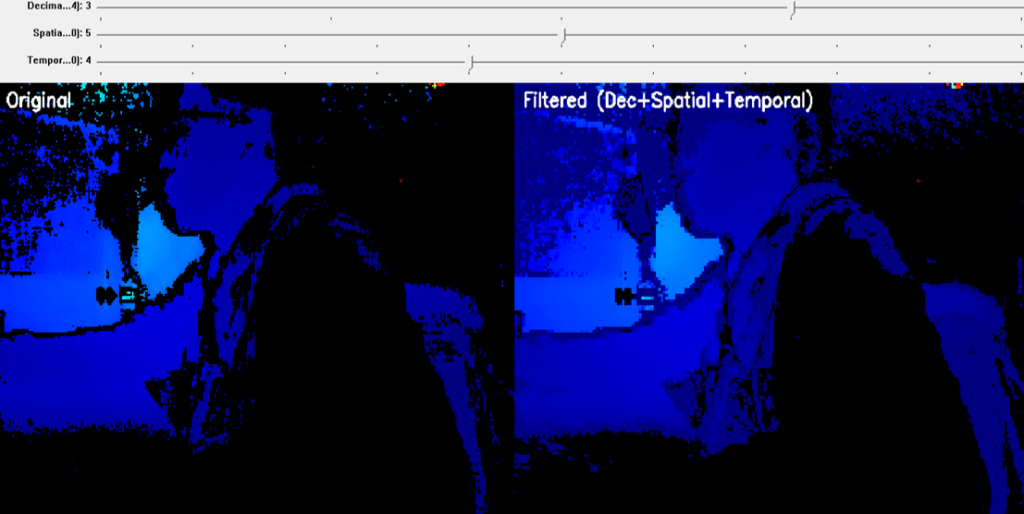
Expected Output #
Prerequisite #
Tutorial #
C++
if (decFactor > 1) {
            Size smallSize(depth16.cols / decFactor, depth16.rows / decFactor);
            resize(depth16, depthDec, smallSize, 0, 0, INTER_NEAREST);
        }
        else {
            depthDec = depth16.clone();
}Decimation
- Reduces resolution by an integer factor (1 = no decimation).
- Uses INTER_NEAREST to avoid interpolating fake depth values.
- Smaller resolution means less noise and faster processing.
C++
Mat depthFloat, depthSpatial;
        depthDec.convertTo(depthFloat, CV_32F);

        int mag = spatial_mag_slider;    // 0~10
        if (mag < 0) mag = 0;

        int diameter = 1 + mag * 2;   // 1,3,5,...,21
        double sigmaCol = 10.0 + mag * 10.0;
        double sigmaSpa = 10.0 + mag * 10.0;

        if (mag == 0) {
            depthSpatial = depthDec.clone();
        }
        else {
            bilateralFilter(depthFloat, depthSpatial,
                diameter, sigmaCol, sigmaSpa);
            depthSpatial.convertTo(depthSpatial, CV_16UC1);
}- Converts depth to
floatfor more accurate filtering. - Uses bilateral filter to smooth noise while preserving edges.
- Filter strength is controlled by
mag(slider): - Larger
mag→ bigger kernel (diameter) and sigmas → stronger smoothing. - If
mag == 0, spatial filtering is effectively disabled.
C++
Mat depthTemporal16;
        int tSlider = temporal_alpha_slider; // 0~10
        if (tSlider <= 0) {
            // No temporal filter
            depthTemporal16 = depthUp;
            hasTemporalPrev = false;  // reset history
        }
        else {
            float alpha = tSlider / 10.0f; // 0.1~1.0 : weight of current frame

            if (!hasTemporalPrev || depthTemporalPrev16.size() != depthUp.size()) {
                depthTemporalPrev16 = depthUp.clone();
                hasTemporalPrev = true;
            }

            Mat curr32f, prev32f, out32f;
            depthUp.convertTo(curr32f, CV_32F);
            depthTemporalPrev16.convertTo(prev32f, CV_32F);

            // out = alpha * current + (1 - alpha) * previous
            out32f = alpha * curr32f + (1.0f - alpha) * prev32f;

            out32f.convertTo(depthTemporal16, CV_16UC1);
            depthTemporalPrev16 = depthTemporal16.clone();
}- Implements a temporal low-pass filter over consecutive frames:
- alpha close to 1 → follow new frame closely (less smoothing).
- alpha close to 0 → very smooth but more “laggy”.
- When disabled (tSlider <= 0), it bypasses the temporal filter.
- Maintains depthTemporalPrev16 as the filtered result of the previous frame